
Removing grouping symbols: Level 2
The relationship of a − b to b − a
We know the relationship of a + b to b + a. They are equal.
a + b = b + a.
But what is the relationship of a − b to b − a ?
a − b is the negative of b − a.
a − b = −(b − a).
For example, 5 − 8 = −(8 − 5).
(Compare Lesson 2.)
Problem 19. Prove: a − b = −(b − a).
To see the answer, pass your mouse over the colored area.
To cover the answer again, click "Refresh" ("Reload").
Do the problem yourself first!
| Solution 1. | a − b | = | a + (−b) |
| = | −b + a | ||
| = | −(b − a). | ||
Solution 2. See Lesson 2, Problem 9.
| Problem 20. | x − 2 2 − x |
= | −1 |
| The fraction has the form: | a −a |
, which for all a (except 0) is equal |
to −1.
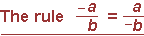
| The Rule: | −a b |
= | a −b |
We may interpret that rule (Lesson 4) to mean:
In any fraction we may change the signs
in both the numerator and denominator.
| Example. Apply that rule to | p − q −2 |
. |
| Answer. | p − q −2 |
= | q − p 2 |
q − p is the negative of p − q.
Problem 21. Apply that rule.
| a) | a − b −c |
= |
b − a c |
b) | 2 − x −5 |
= |
x − 2 5 |
| c) | −x + y − z −4 |
= |
x − y + z 4 |
d) | −x − 1 2 |
= |
x + 1 −2 |
= | − |
x + 1 2 |

Next Lesson: Adding like terms
Please make a donation to keep TheMathPage online.
Even $1 will help.
Copyright © 2021 Lawrence Spector
Questions or comments?
E-mail: teacher@themathpage.com